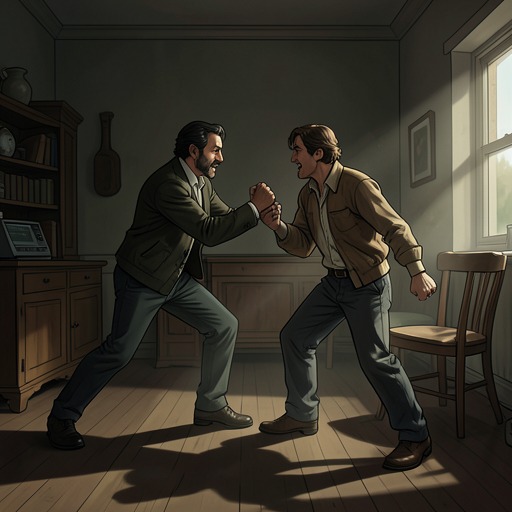
Tracy strikes Rebus in the groin and flees the car
Hide and SeekTracy strikes Rebus in the groin and flees the car, turning an interrogation into a sudden reversal of control. Rebus has brought her to an address she recognizes and confronts her with a photograph and his theory that she helped Hutton obtain Ronnie McGrath’s work. But the theory is not confirmed: Tracy’s flight interrupts the questioning, leaving suspicion and a physical injury in place of an answer.
The address and the photograph
Rebus pulls abruptly to the kerb and stops beside a tenement whose red stone has been cleaned within the past year. The change has made the building look almost pliable, pinky ochre like a child’s plasticine. Tracy looks out, repeats her question about where they are, and then recognizes the exact address. She tries not to show that she knows it. Her recognition precedes Rebus’s explanation, making the destination itself part of the pressure: he has brought her somewhere familiar to her, though the scene does not establish why she knows it.
The photograph is on Tracy’s lap. When she turns from the window, she flicks it away with a squeal, as if it were an insect. Rebus retrieves it from the floor and holds it out, identifying it as hers. Her immediate question is how he got it. His is whether she wants to explain it. The exchange makes the image more than a piece of evidence: it is an object she recoils from and Rebus can use to press her, while its presence in the car forces an encounter she would rather avoid.
Rebus’s accusation
Rebus proposes going to see Hutton and asking about the photograph, the money he says Hutton paid Tracy to model, and the possibility that she brought him Ronnie McGrath’s pictures. He offers two possible reasons: she wanted a little more money, or she wanted to spite Ronnie. In Rebus’s reconstruction, Hutton then used Ronnie’s ideas, while Ronnie could not prove where Hutton had got them. Rebus further suggests that Tracy blamed Charlie, which could explain why she and Charlie were no longer on speaking terms.
These are pointed accusations, not established findings. The narration explicitly marks Rebus’s account as conjecture: he thinks Hutton might confirm the details if pressed, and imagines that Tracy modelled for money and mentioned that her boyfriend was a photographer. The scene therefore keeps two things distinct: Tracy recognizes the address and recoils from the photograph, but the proposed chain linking her, Hutton, and Ronnie’s pictures remains Rebus’s theory. His language is designed to make that theory hurt. He calls her a poor friend to Ronnie and invokes the possibility that she betrayed someone who trusted her.
Tracy breaks down and weeps at length, giving up her attempt to free herself from the seatbelt. Her reaction does not by itself prove the accusation. Rebus is not proud of his method, but believes the truth has to be faced. He has already left her overnight in the cells to see whether she would crack; she did not. That earlier failure to get an admission shapes this confrontation, where he presses harder but still has no confirmation. He also suspects she may have a habit and need money, while acknowledging uncertainty about what, if anything, she uses. Those suspicions supply a possible context for his money theory, not proof of her actions.
The attack and escape
After the accusation, Tracy settles back against the seat and asks whether they have to remain there. Her hands begin to rise as if to clasp her head. Rebus starts to answer, but the gesture changes: her hands drop swiftly and curl into fists. Confined in the car, he has no room to get clear before she hits him full in the groin. The speed of the movement turns apparent distress into an assault, and the scene’s balance shifts at once from Rebus’s control of the questioning to his inability to stop her.
The blow produces a flash of pain that leaves the world, for Rebus, reduced to sound and blinding sensation. Doubled over, he falls against the steering wheel, setting off the horn. While it blares, Tracy unfastens her seatbelt, opens the door, and swivels out. She leaves the door wide open as she runs. Rebus can only watch through tear-brimmed eyes, the image rendered as if he were in a swimming pool, following her along its edge while chlorine stings his pupils. The open door and sounding horn mark her abrupt departure; his body, hunched over the wheel, cannot pursue her.
The aftermath and reversal
Rebus gasps in pain and expects to remain bent over the wheel for some considerable time. His mind turns to advice his father once gave him about fights at school: think like Tarzan, stay strong, and protect the groin. Remembering the advice now, after failing to protect himself, he addresses his father bitterly before nausea overtakes him. The memory supplies a grim comic edge, but it does not lessen the force of the injury or restore Rebus’s authority in the moment.
The episode ends with Tracy outside the car and Rebus incapacitated inside it. She has escaped before he can establish whether his allegations are true, while he is left with an unanswered question and a humiliating physical consequence. The reversal matters to the investigation precisely because it is not a confession: the photograph and her recognition of the address intensify suspicion, but the assault cuts off the exchange rather than resolving it. Rebus’s attempt to make Tracy stop hiding from the truth leaves him, instead, unable to follow her.